
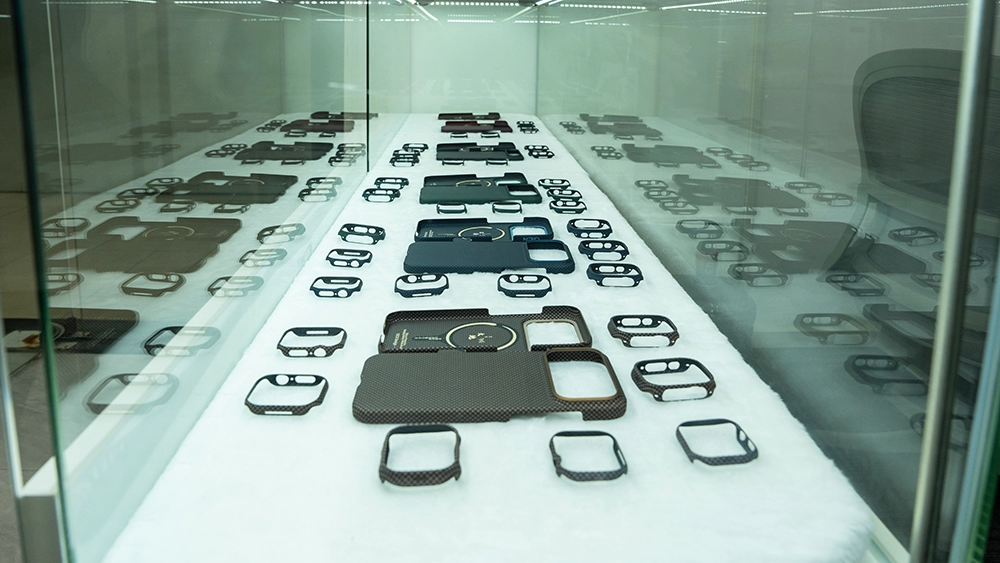
Two aramid fiber phone cases can use the same fiber, the same resin, and the same overall construction and still look completely different, because the weave pattern controls how light moves across the surface. The weave is also more than decoration: it influences surface texture, how the laminate behaves at curved edges, and how the finish ages.
This guide covers the weave patterns used in aramid fiber phone cases and what each one changes in the finished product.
Why the Weave Is Visible at All
Aramid fiber is supplied as a fabric woven from bundles of fine filaments. When that fabric is laminated with resin and formed into a shell, the fabric structure stays intact underneath the surface. Light reflects differently off the raised and recessed yarns, which is what produces the characteristic pattern.
Because the pattern comes from the physical structure, it has depth. Unlike a printed texture, it shifts as the case moves in your hand and it does not wear off, because there is no ink layer to remove.
The Core Weave Patterns
Plain weave
In a plain weave, each warp yarn passes over one weft yarn and under the next, alternating every single strand. The result is a tight, uniform, checkerboard-like grid with a relatively flat surface.
Characteristics in a phone case:
- The tightest and most dimensionally stable structure
- A finer, more subtle appearance, especially at small yarn sizes
- Less drape, which can make very tight curved edges harder to form cleanly
- A surface that reads as technical and understated
Twill weave
In a twill weave, yarns pass over two or more strands before going under, and each row shifts by one position. This produces the diagonal lines most people associate with aramid and carbon fiber.
Characteristics in a phone case:
- The distinctive diagonal texture, with more visual depth than plain weave
- Better drape and conformability, which helps on rounded edges and corners
- A slightly softer surface feel than a tight plain weave
- The most widely recognized "fiber" look, and the most common choice for premium cases
Twill is available in several variants, described by the over/under pattern, such as 2x2 or 4x4, and each variant changes the scale and angle of the visible diagonal.
Specialty and hybrid weaves
Beyond the two basics, manufacturers use basket, satin, and jacquard-style constructions, and some combine aramid yarn with a second yarn type to create color accents or geometric motifs. These are chosen for appearance and are common in cases positioned as design objects rather than plain protective shells.
Specialty weaves usually cost more because they are slower to produce, and they can be less forgiving to laminate if the pattern is open or has long floating yarns.
How Yarn Size Changes the Look
The same weave pattern looks dramatically different depending on yarn size, usually expressed as a linear density.
- Fine yarn: a dense, smooth, almost fabric-like surface. From a distance it reads as a subtle texture rather than an obvious pattern.
- Medium yarn: the balanced default, with the weave clearly visible but not overpowering.
- Coarse yarn: a bold, tactile pattern with pronounced depth. Fun to hold, but it can look busy on a small phone case and may collect dust in the recesses.
Yarn size also interacts with case thickness. A coarse weave on a very thin shell can look disproportionate, while a fine weave on a thick shell may disappear entirely.
What the Weave Does Not Change
It is worth being clear about the limits. The weave pattern is not the main driver of impact protection. Protection comes from shell thickness, corner reinforcement, raised camera edges, and how the rigid shell is joined to any inner liner.
Weave choice also does not determine signal transparency, because that comes from aramid fiber being electrically insulating regardless of how it is woven.
What the weave does change is appearance, surface feel, edge formability, and how the finish wears. Those are real product decisions, but they are different decisions from protection.
Specifying a Weave for Production
When ordering, the useful approach is to define the weave in terms that a supplier can confirm and repeat:
- Pattern: plain, twill, or specialty, and if twill, the specific pattern variant
- Yarn size: the linear density or the fabric weight, so the texture scale is reproducible
- Areal weight: the fabric weight per unit area, which drives both look and laminate thickness
- Finish: matte or glossy, plus any surface treatment for fingerprint resistance
- Color: natural weave, dyed yarn, or accent yarns, with a reference sample
Ask for samples in the exact weave and finish you intend to buy. A supplier's catalog photo taken under studio lighting will not tell you how a pattern reads under normal indoor light, and small differences in yarn size are much easier to judge by holding two samples side by side.
Practical Takeaways
If you want a case that looks refined and understated, a fine plain weave with a matte finish is a safe direction. If you want the recognizable fiber look with good edge forming, a twill weave with a medium yarn is the conventional premium choice. If the case is meant to be a visual signature, a specialty or hybrid weave gives more room to differentiate, at a higher cost and with more process risk.
Whichever you choose, confirm the pattern, yarn size, areal weight, and finish in writing before production, and approve a physical sample rather than a screen image.